Simple Sourdough Calculator
Baker’s percentages · Real-time calculations · Fermentation schedule
Basic Settings
Tell us about your bakeFlour Composition
Percentages must total 100%Your Recipe
All weights calculated in real-time- Feed your starter 4–12 hours before mixing dough. It should be bubbly and at peak activity — the float test can help verify.
- Autolyse your flour and water for 30–60 minutes before adding starter and salt. This develops gluten effortlessly.
- Perform 4 sets of stretch-and-folds during bulk fermentation, spaced 30 minutes apart, for a strong gluten network.
- Bulk fermentation is complete when the dough has grown 50–75% in volume and feels airy and jiggly.
- Cold-proof your shaped loaf in the fridge for 8–16 hours for a more complex flavor and easier scoring.
- Bake in a Dutch oven — preheat to 500°F (260°C). Bake covered for 20 min, then uncovered for 20–25 min until deep golden brown.
- Let your bread cool completely (1–2 hours) before slicing. Cutting too soon traps steam and gums up the crumb.
- Higher whole wheat or rye percentages speed up fermentation — reduce bulk time or lower dough temperature accordingly.
Baker’s percentage expresses every ingredient as a percentage of the total flour weight. Flour is always 100%. This makes recipes easy to scale up or down.
FORMULA
Ingredient weight = (Baker’s % ÷ 100) × Total Flour Weight
Example: 70% hydration with 500g flour = 350g water
Sourdough Hydration
Sourdough hydration refers to the ratio of water to flour in your dough, expressed as a percentage. Most home bakers typically work within a range of 65% to 80% hydration.
This percentage provides valuable insight into several aspects of your dough: how sticky it will be, how it will ferment, the type of crumb you can expect, and the level of difficulty in shaping it. As you can see, this single number holds significant importance.
This guide will cover everything you need to know about sourdough hydration, including what it means, how to calculate it, which hydration level is best for you, and the effects of adjusting it up or down. Additionally, there’s a free interactive calculator provided below, so you won’t have to do the calculations by hand.
Sourdough Starter Hydration
The hydration level of your sourdough starter plays a significant role in the baking process and should not be overlooked.
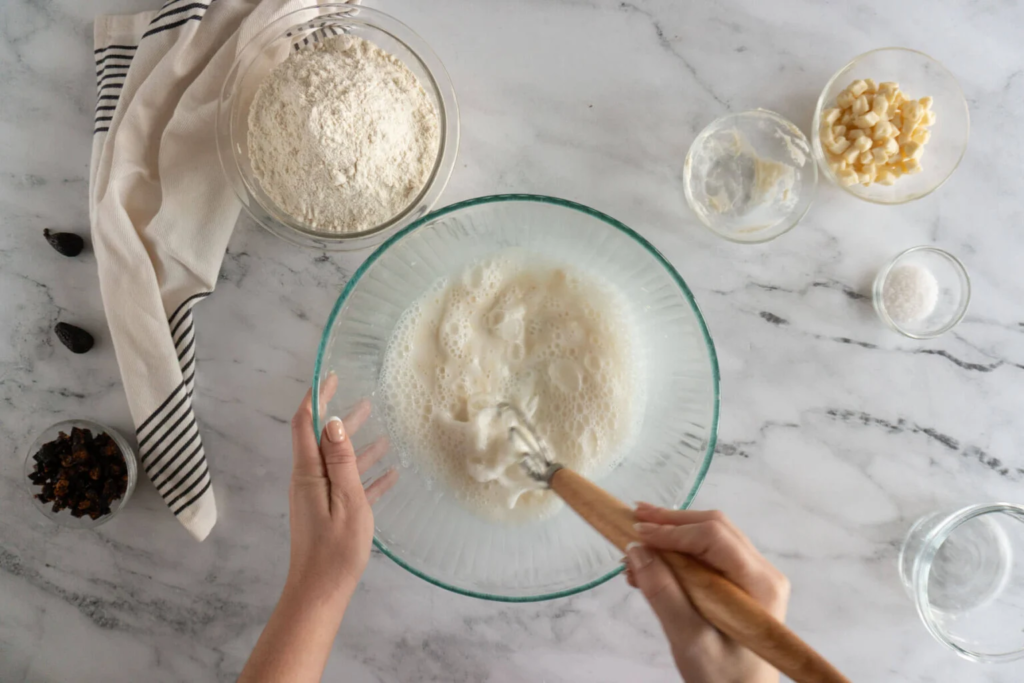
A 100% hydration starter is the most common type found in bakers’ kitchens because it is easy to maintain. A 100% hydration starter means that for every feeding, you use equal weights of water and flour. For example, you would mix 50g of starter with 50g of water and 50g of flour.
In contrast, a stiff starter, also known as Lievito Madre or pasta madre, has a lower hydration level of around 50%. This type of starter has a dough-like texture and is fed with more flour than water.
Regardless of the type of starter you choose, maintaining a consistent hydration level is essential for achieving reliable results in your baking.
If you’re brand new to sourdough, I genuinely recommend starting around 68-72% so you can learn to shape without fighting your dough. A small loaf of sourdough is a great place to start!
Why Is Knowing Hydration Important?
Hydration is not merely a number: it is the factor that controls nearly everything about how your dough behaves from the moment you mix it until it comes out of the oven. Here’s what changes when you adjust this variable:
Dough Texture And Workability
This is the change you’ll notice right away. Higher hydration results in stickier, wetter, and more extensible dough, while lower hydration creates firmer dough that maintains its shape and is easier to handle, especially for beginners.
What Is Sourdough Hydration?
Sourdough hydration refers to the percentage of water in your dough compared to the total weight of flour used. To calculate hydration, divide the weight of water by the weight of flour and then multiply the result by 100.
For example, if your recipe includes 350 grams of water and 500 grams of flour, the dough has a hydration level of 70%. This is calculated as follows: (350/500) = 0.7, and then multiplying by 100 gives you 70%.
That’s the entire concept!
Why Express Sourdough Hydration As A Percentage?
Bakers express it as a percentage because it scales easily.
Once you know a recipe is 70% hydration, you can scale it up or down to any batch size and keep the ratios exactly right. It also makes it easy to compare recipes and understand why one dough behaves differently from another.
Frequently Asked Questions
What is Baker’s math or Baker’s percentages?
Baker’s math is a useful method for adjusting ingredient quantities in bread baking. In this system, the weight of flour in your recipe is always set at 100%, while the weights of all other ingredients are expressed as percentages of the total flour weight. For home bakers looking to create the perfect sourdough, I have based my calculator on the following percentages:
– 100% Flour
– 67% Water
– 20% Starter
– 2% Salt
How much Starter do I use?
I use a 100% hydration starter as a guideline in my calculations. When baking sourdough, I typically use between 20% and 25% starter. The amount of starter you choose depends on how quickly you want the fermentation to occur and the temperature of your kitchen. Generally, the amount of starter ranges from 10% to 50%. You can use a slider to experiment and take notes on what works best in your kitchen.
The calculator is set to use 25% starter relative to the flour amount. In warmer temperatures (above 20°C/68°F), it’s advisable to use less than 20% starter, while in cooler temperatures (below 19°C/66°F), you should increase the starter to more than 25%.
Lets talk Salt.
Salt should be 2% of the flour. I prefer using kosher or sea salt in my breads.
What is Hydration?
The hydration determines the texture, crust, flavour and appearance of your bread.Hydration
Description
50%-59%
Easy to knead, non-sticky dough. Bread will be firmer.
60%-75%
Dough becomes slightly sticky and harder to knead. Bread will be softer with a tight crust. Great for a beginner sourdough baker. As a beginner work between 65%-70% hydration.
76%-90%
The dough becomes sticky and hard to handle, use a mixer with a dough hook for kneading. Bread will be light with a thin-crust.
How to use my Calculator.
Add the amount of flour you want to use, and the calculator will determine the rest. Use the slider to adjust the water or starter quantities to achieve your desired hydration level.